

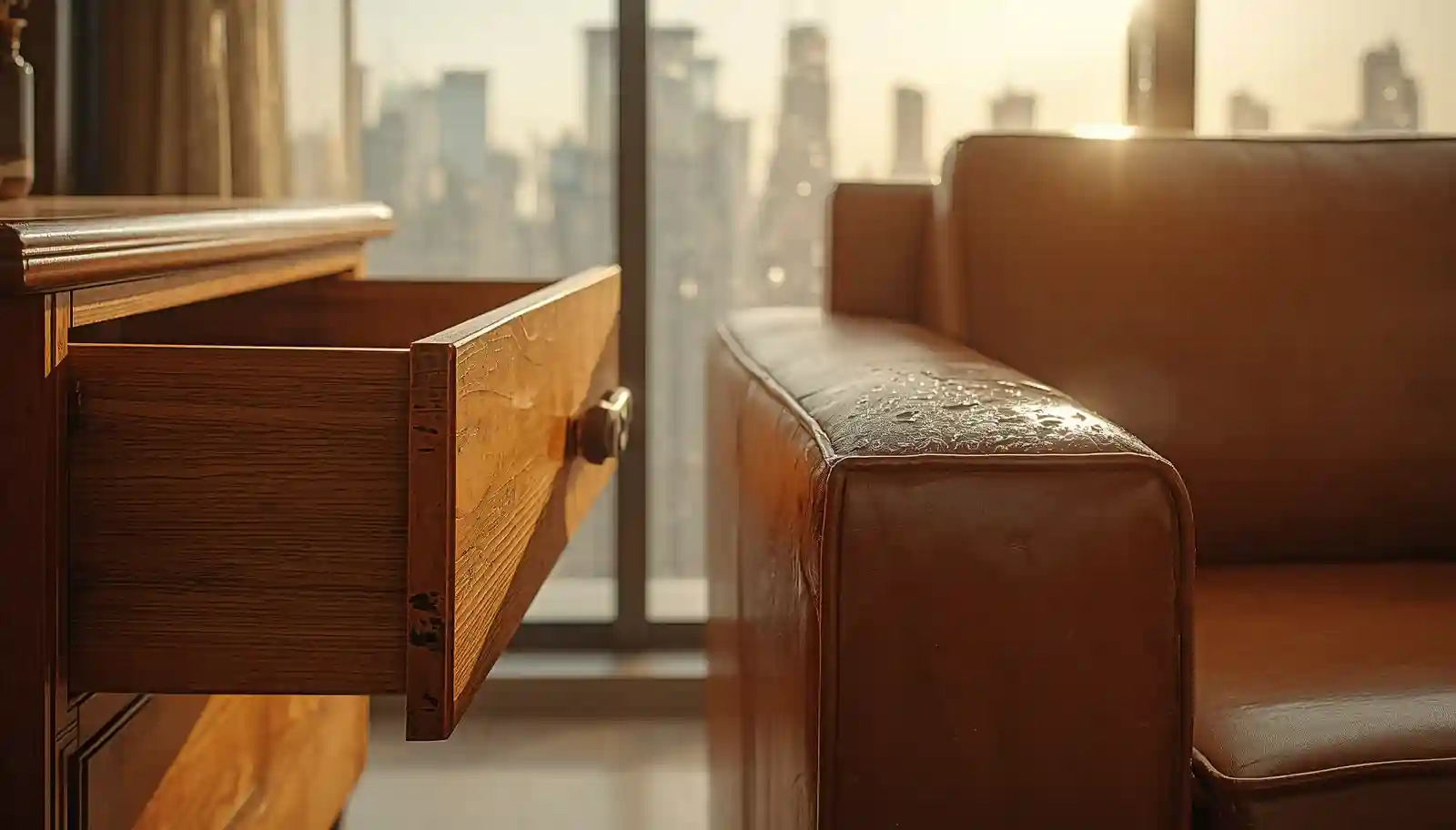
How Does Dubai Humidity Affect Furniture?
If you have ever noticed your wooden drawer sticking in summer, your leather sofa feeling stiff by October, or a faint musty smell coming from upholstered pieces near the window, Dubai’s humidity is almost certainly the cause. This guide explains exactly how humidity affects different furniture materials, how to spot early damage, and what you can do to prevent it from becoming expensive.
By the end, you will know how to protect what you already own and what to look for when buying new pieces.
Why Humidity Is a Bigger Threat Than Heat Alone?
Most Dubai residents consider heat the enemy of furniture. Heat matters, but humidity is the variable that does the quieter, more structural damage.
Dubai’s relative humidity ranges from around 50% in winter to above 90% on coastal summer days. Indoors, aggressive air conditioning pulls that figure down to 30% or lower. Your furniture moves between those two extremes repeatedly, sometimes within the same day.
According to research published in the Wood Science and Technology Journal, wood can change dimensionally by up to 4% across its grain for every significant shift in moisture content. That movement, repeated hundreds of times a year, is what loosens joints, warps tabletops, and separates veneers.
Heat accelerates the process. Together, they are significantly more destructive than either would be alone.
How Humidity Damages Different Furniture Materials?
1. Wood Furniture
Wood absorbs moisture from the air when humidity rises and releases it when the air dries out. Each cycle causes expansion followed by contraction. Over time, this produces:
- Joint loosening: The mortise-and-tenon or dowel joints that hold chairs, tables, and bed frames together gradually work loose
- Warping: Flat surfaces like tabletops and shelf boards curve as moisture distributes unevenly across the grain
- Veneer separation: The thin decorative layer lifts away from the substrate when the two materials expand and contract at different rates
- Checking: Small surface cracks in the finish or the wood itself, usually following the grain
Solid hardwood handles this cycling better than engineered wood or MDF-core furniture. Teak is particularly well-suited to Gulf conditions because of its natural oil content, which buffers moisture absorption.
PRO TIP: Tap the underside of a suspect joint with your knuckle. A hollow sound means the adhesive bond has broken. Catching this early means a furniture restorer can re-glue it. Left too long, the joint fails structurally.
2. Leather and Faux Leather
Genuine leather is a porous material. In high humidity, it can absorb excess moisture, which encourages surface mould and causes the material to feel tacky or develop a faint smell. When the AC then dries the air aggressively, that same leather loses its natural oils faster than in temperate climates.
The result is leather that cycles between slightly damp and overly dry, which accelerates surface cracking at stress points: the front edge of seat cushions, armrest curves, and the back panel where it flexes when someone sits.
Faux leather (PU or bonded leather) has a different failure mode. The adhesive layer between the fabric backing and the polyurethane surface is vulnerable to the combination of heat and humidity. Once delamination begins, the surface peels in patches and is not repairable.
If your faux leather sofa is more than three years old and showing any surface bubbling or lifting, especially near seams, humidity cycling has likely already begun the delamination process. Address it with a leather repair kit early or plan for replacement.
3. Fabric and Upholstery
Fabric faces two distinct humidity-related threats in Dubai:
Mould and mildew develop in the padding and backing layers of upholstered pieces in rooms with poor airflow, inadequate AC drainage, or coastal proximity. The surface fabric often looks fine, while the interior foam has already developed spores. The first sign is usually a faint musty smell that does not go away after airing the room.
Accelerated wear happens because dust particles in high-humidity environments clump slightly rather than remaining dry. This particulate matter acts as an abrasive when compressed between fabric fibres during normal use, breaking down the weave faster than in dry climates.
Signs Your Furniture Already Has Humidity Damage
Catching damage early is significantly cheaper than addressing it after it progresses. Look for these indicators:
| Material | Early Signs | Advanced Signs |
| Solid wood | Drawers sticking, slight surface dullness | Warped tops, visible joint gaps, checking |
| Veneered wood | Slight edge lifting at corners | Full veneer separation, bubbling |
| Genuine leather | Dryness, slight stiffness | Surface cracking, colour loss |
| Faux leather | Surface bubbling near seams | Peeling, delamination patches |
| Upholstery | Musty smell, slight colour shift | Visible mould, fabric breakdown |
| Metal hardware | Light surface oxidation | Rust, seized mechanisms |
How to Protect Your Furniture From Dubai Humidity?
Control the Indoor Climate First
The most effective protection is not a product. It is the consistency of the environment.
- Set your AC to a consistent temperature between 22 and 25°C rather than letting it swing dramatically when you leave and return home.
- Use a hygrometer (available for under AED 30 at most hardware stores) to check your indoor humidity. Target 45 to 55% relative humidity
- If your indoor air consistently reads below 35% humidity, a small room humidifier near valuable wood pieces significantly reduces stress on the material.
- Direct AC airflow away from furniture pieces, particularly wood and leather
Wood-Specific Protection
- Apply a quality furniture wax or conditioner every three months, more frequently during peak summer.
- Keep wood pieces at least one metre from windows to reduce UV exposure, which dries surface finishes.
- Use coasters and felt pads consistently to prevent finish damage that lets moisture penetrate
Leather Care Routine
- Condition genuine leather every six to eight weeks in Dubai’s climate, roughly twice the frequency recommended for European conditions
- Use a conditioner with UV inhibitors built in
- Wipe down weekly with a barely damp microfibre cloth to remove salt residue from skin contact.
- Never use household cleaning sprays directly on leather; they strip the protective finish.
Fabric and Upholstery
- Vacuum weekly using an upholstery attachment to remove clumped dust before it abrades the weave.
- Apply a fabric protector spray at the start of each summer season
- In coastal areas or any home unoccupied for extended periods, lift cushions monthly to check the padding layer for early mould development
- Run the AC in dehumidifier mode periodically if available on your unit
Common Myths About Humidity and Furniture
Myth 1: “If furniture looks fine on the surface, it is fine”
This is the most expensive assumption Dubai furniture owners make. Veneer separation, joint loosening, and foam mould all develop from the inside out. By the time damage is visible on the surface, the structural or material problem has usually been progressing for months. Regular tactile checks (pressing joints, smelling upholstery, checking drawer fit) catch problems that visual inspection misses entirely.
Myth 2: “Air conditioning eliminates humidity damage”
AC systems remove significant moisture from the air, but they also create the opposite problem: over-dried interiors. The damage cycle in Dubai is not high humidity alone. It is the swing between high outdoor humidity and artificially dry indoor air. AC reduces one extreme while creating another. Managing that swing with a hygrometer and targeted humidification is a more complete approach than relying on AC alone.
Myth 3: “Sealed or lacquered wood does not absorb moisture”
Surface finishes slow moisture exchange, but do not stop it. Wood is hygroscopic at a material level, and moisture enters through the end grain, the underside of pieces, and any finish imperfection. Sealed furniture still needs conditioning and still moves with humidity changes. It just does so more slowly.
Does Furniture Built for Dubai’s Climate Perform Differently?
The honest answer is yes, significantly.
When furniture is designed and manufactured with Gulf climate conditions in mind, the material selection, joinery method, finish type, and fabric choice all account for humidity cycling. The result is a piece that handles those stresses as part of its design rather than despite them.
This is one of the strongest arguments for custom home furniture in Dubai over imported off-the-shelf alternatives. RAM Furniture, one of Dubai’s leading custom furniture makers, builds pieces specifically for how homes in this region actually behave across seasons. Our team can guide you on which materials handle Dubai’s humidity cycles best for your specific environment, whether that is a sea-facing apartment in Dubai Marina or an inland villa in Arabian Ranches.
A piece built for where it will actually live requires less maintenance, lasts longer, and performs better from day one.
FAQs
Does Dubai humidity damage furniture faster than heat?
Both are contributing factors, but humidity cycling, the swing between high outdoor humidity and low indoor humidity from the AC, produces more structural damage over time than heat alone. Heat accelerates the process, but the dimensional movement caused by moisture change is the primary mechanical stressor.
How do I know if my wooden furniture has humidity damage?
Check drawers for sticking or looseness (both indicate movement), press joints to test for stability, look at veneer edges under good light for any lifting, and run your hand across flat surfaces to check for warping. Early signs are usually functional before they become visual.
Can mould grow inside furniture in Dubai?
Yes, particularly in upholstered pieces in coastal areas, rooms with AC drainage issues, or homes left closed during extended travel. Mould develops in foam padding and fabric backing before it is visible on the surface. A musty smell that persists after airing the room is the primary indicator.
What indoor humidity level is safe for furniture in Dubai?
Between 45% and 55% relative humidity is the recommended range for wood and leather furniture. Below 35%, wood becomes prone to drying damage, and leather loses oils rapidly. Above 65%, mould risk increases significantly.
Is it worth conditioning furniture if it already looks damaged?
For surface-level dryness and minor finish checking, conditioning can stop further progression and partially restore the material. For structural joint failure, veneer separation, or established mould, professional restoration is necessary. Conditioning alone will not reverse mechanical damage.
Conclusion
Dubai’s humidity does not announce itself. It works quietly, through seasonal cycles and daily indoor-outdoor transitions, and the damage accumulates before most people notice it. The good news is that it is almost entirely manageable with the right knowledge and a consistent routine.
RAM Furniture takes that approach seriously. Our custom furniture Dubai offering is built around Gulf living conditions, so your pieces arrive already adapted to what they will face, not working against it.
Protect what you already own with regular conditioning, stable indoor climate, and early detection habits. And when it is time to buy new pieces, consider furniture that was designed for this climate from the start.